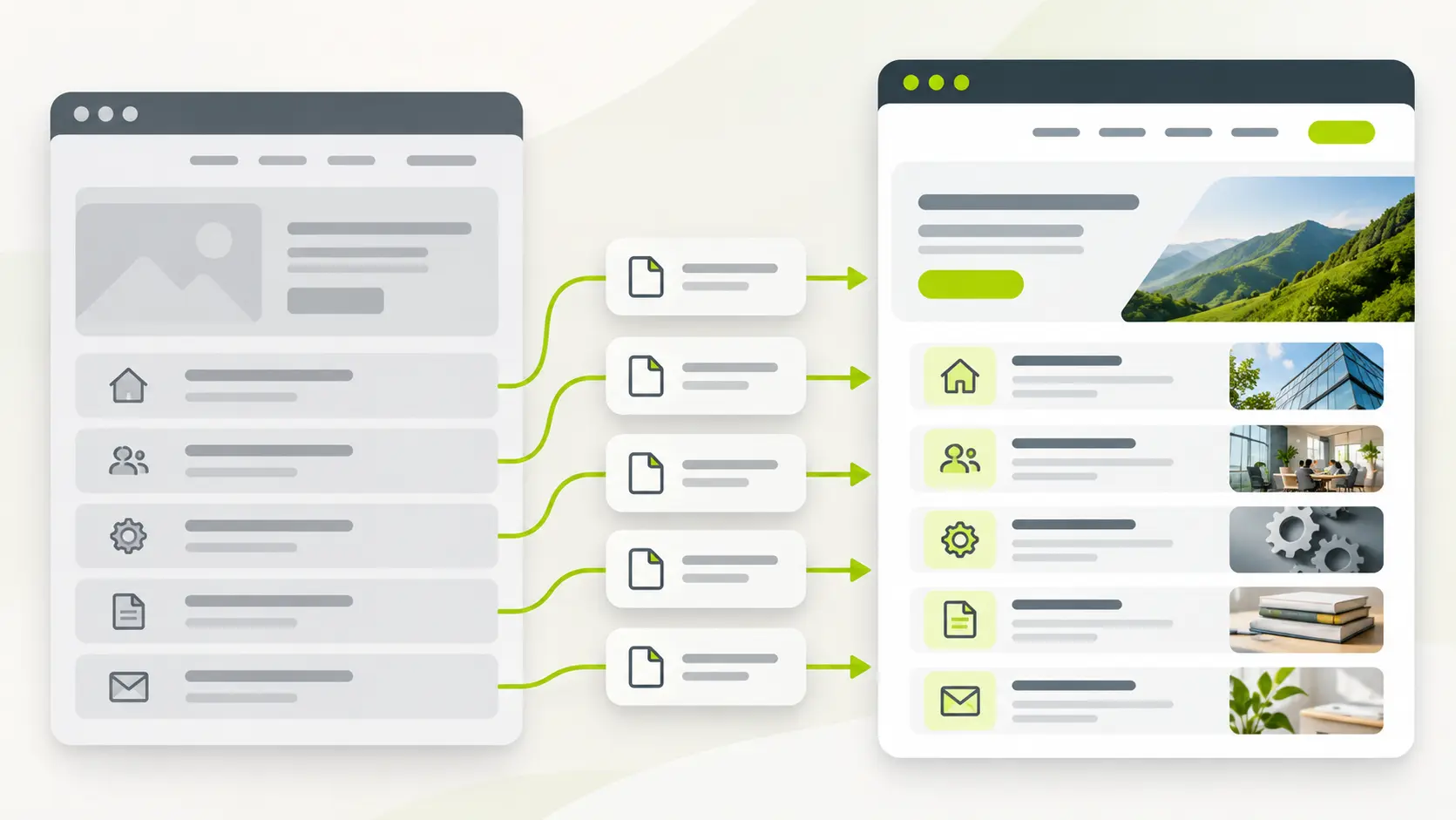
Website RFP examples: three sample RFPs you can adapt
Three filled-in website RFP examples (home services, nonprofit, online store), what they have in common, and how to turn one into your own.

A website RFP example is more useful than a template because you can see how the sections read once filled in. Below are three short sample RFPs, written as the text a business would send to agencies. All three companies are invented. If you want the blank template, it is here: RFP for website design and development.
Each sample is around 200 words, on purpose. A small business RFP needs clear goals and a budget range, not 30 pages.
What does a website RFP look like for a home services company?
Request for proposals: website replacement for Brightline Home Services (invented company)
Background. We are a 12-person HVAC and plumbing company serving Bergen and Passaic counties in New Jersey. Our WordPress site went live in 2017. It loads slowly on phones, the contact form breaks after plugin updates, and nobody on staff can edit it.
Goals. Increase booked service calls by making it easy to request service on a phone. Rank in local search for "HVAC repair" and "plumber" plus our town names. Let our office manager update pages without a developer.
Scope. About 25 pages: home, 8 service pages, 10 town pages, about, reviews, careers, contact. Migrate 40 blog posts with redirects.
Must-haves. Mobile-first design. Click-to-call on every page. A service request form that routes by town. Pages that pass Core Web Vitals. A redirect map for every old URL.
Integrations. Jobber for service requests. Google Business Profile. GA4 and Search Console with form tracking.
Budget range. $15,000 to $25,000 for design and build. Hosting and care quoted separately.
Timeline. Proposals due in three weeks. Launch within 12 weeks, before the summer AC season.
Evaluation criteria. Local service work (30%), local SEO and redirect approach (25%), price (25%), who does the work (20%).
How to respond. One PDF, 10 pages or fewer, with three references. We will shortlist three firms for a call.
What does a website RFP look like for a small nonprofit?
Request for proposals: new website for Greenpoint Harbor Youth Alliance (invented organization)
Background. We are a community nonprofit in Brooklyn running after-school programs for about 300 teenagers a year. Our site is a free page builder template from 2020. Donations send people to another domain, and event sign-ups happen by email.
Goals. Make it simple to donate once or monthly without leaving our site. Let families register for events online. Show funders our impact on a page we update quarterly.
Scope. About 15 pages: home, programs (4), events calendar, donate, impact, team, volunteer, press, contact.
Must-haves. Embedded donation flow with recurring giving. Event pages with registration and capacity limits. WCAG 2.1 AA accessibility. Spanish and Polish toggles for key pages. Staff publish news after one hour of training.
Integrations. Bloomerang (donor CRM). Mailchimp. Google Calendar.
Budget range. $12,000 to $18,000. We are a 501(c)(3); please quote your standard rate and note any nonprofit discount.
Timeline. Proposals due in four weeks. Launch before our spring fundraising campaign in late March.
Evaluation criteria. Nonprofit experience with donations and events (35%), accessibility approach (20%), price (25%), training and handover plan (20%).
How to respond. PDF plus two live nonprofit sites you built. Our executive director and one board member will review.
What does a website RFP look like for a brand opening its own store?
Request for proposals: direct-to-consumer store for Catskill Larder (invented brand)
Background. We sell small-batch hot sauces and pickles from the Hudson Valley, mostly through a large marketplace and two wholesale accounts. Marketplace fees keep rising and we never see who our customers are, so we want our own store.
Goals. Launch a store that handles 60 SKUs, subscriptions for our monthly box, and password-protected wholesale ordering. Own our customer list.
Scope. Shopify or equivalent, theme customization, product import from the marketplace export, a wholesale section, and a short launch SEO checklist.
Must-haves. Subscriptions, gift cards, shipping rules for heavy glass jars, sales tax for New York and the other states we ship to, and a mobile checkout that works in two taps.
Integrations. ShipStation, Klaviyo, QuickBooks.
Budget range. $10,000 to $16,000, plus platform and app fees.
Timeline. Proposals due in two weeks. Live within 10 weeks, ahead of the holiday season.
Evaluation criteria. Comparable store work (40%), price (30%), post-launch support (30%).
How to respond. Short PDF with two comparable stores you built and references. The two founders will review.
This one is deliberately brief. A store RFP has its own questions (payments, inventory, shipping, returns), and the full checklist is in our ecommerce website RFP post.
What do all good website RFP examples have in common?
Good website RFP examples state a business goal, give a budget range, name integrations, and explain how proposals will be scored.
Look at a real one. The City of Exeter, California posted a website redesign RFP in August 2026 with background, scope, technical requirements, a schedule and a 100-point evaluation table: qualifications, design and technical capability 20 points each, accessibility 15, approach and training 10, cost 15.
The samples above borrow that structure. Each explains why the project exists (slow phones, a donation flow that leaves the site, marketplace fees), not only what to build. An agency reading "increase booked service calls from phones" can propose click-to-call. One reading "we want a modern site" can only guess.
The other shared trait is a response format. Page limits, a reference count and a named reviewer make proposals comparable. To score what comes back, read how to evaluate web development proposals.
What do bad website RFP examples get wrong?
Bad website RFPs leave out the budget, list features without goals, and ask for free design mockups.
No budget. Owners hide the budget hoping for a lower price. In practice, agencies guess high, guess low and change scope later, or skip the RFP because they cannot tell an $8,000 job from an $80,000 job. The Exeter RFP collects one-time and recurring costs on a fixed form so bids line up. A private company can simply give a range.
Features without goals. "Blog, gallery, testimonials, chatbot, parallax hero" is a shopping list. It does not say what success looks like, so the agency cannot push back on items that will not matter.
Free mockups. Asking for homepage designs with the proposal filters for agencies with spare capacity, not the best fit. Serious firms decline or recycle old work. Ask for comparable live sites.
No decision process. If bidders do not know when and who decides, good ones move on.
How do you adapt an example to your business?
Start from the sample closest to your situation, rewrite the background and goals in your own words, then change scope, integrations and budget. Keep the section order.
- Write the background first and keep it honest. "The form breaks after plugin updates" beats "we want a refresh."
- Turn each complaint into a goal. Slow site becomes "pass Core Web Vitals on mobile."
- List integrations by product name. Agencies price them differently depending on the tool.
- Add a short SEO requirement. Google's SEO starter guide, updated in December 2025, says a good title is unique to the page, clear and concise, and describes its content, and that Google needs to access the same resources as a user's browser. Two lines on unique titles, descriptive URLs, redirects and no blocked resources prevent most ranking losses.
- Set a budget range and a scoring table. Even four lines change how agencies write back.
- Name the reviewer and the response format. One PDF, page limit, references, due date.
Quick answers
Do public sector website RFP examples apply to a small business?
Partly. City and university RFPs are good models for structure: background, scope, evaluation criteria and a response format. Skip what they carry for legal reasons: insurance certificates, bonding, formal Q&A periods and 40-page terms. A small business version keeps the skeleton and drops the ceremony, which is what the three samples above do.
Can I copy a website RFP example word for word?
Copy the structure, not the content. Agencies read dozens of RFPs and spot a pasted one at once, and a borrowed goals section means the proposals solve someone else's problem. Rewrite background, goals and must-haves in your own words, keep the headings, and the sample has done its job.
What is the difference between an RFP and an RFQ for a website?
An RFP asks firms to propose how they would solve your problem and what it would cost. An RFQ asks for a price on a scope you have already fixed. Wise's procurement guide from June 2025 puts it simply: an RFP is sent when your organization already knows what it needs, and an RFQ focuses on price. For most website projects an RFP is the right tool.
Where can I find public website RFPs?
Many US cities, counties and universities post website RFPs on their procurement or news pages. The City of Waverly, Iowa posted a website redesign RFP notice in February 2026 with a due date and submission instructions, and the City of Exeter PDF above is a complete one. Search "website redesign RFP" plus the year and ".gov" for more.
Next step
If you want a second opinion on your RFP before you send it, book a free call. Our developers and SEO people are one team, so we can tell you quickly whether scope, budget and SEO fit together. You leave with a written recommendation, whether or not we work together.