MVP vs Prototype vs Proof of Concept: Which One Do You Need?
A PoC proves it can be built, a prototype proves people understand it, an MVP proves people will pay. Here is how to pick the right one for your idea.
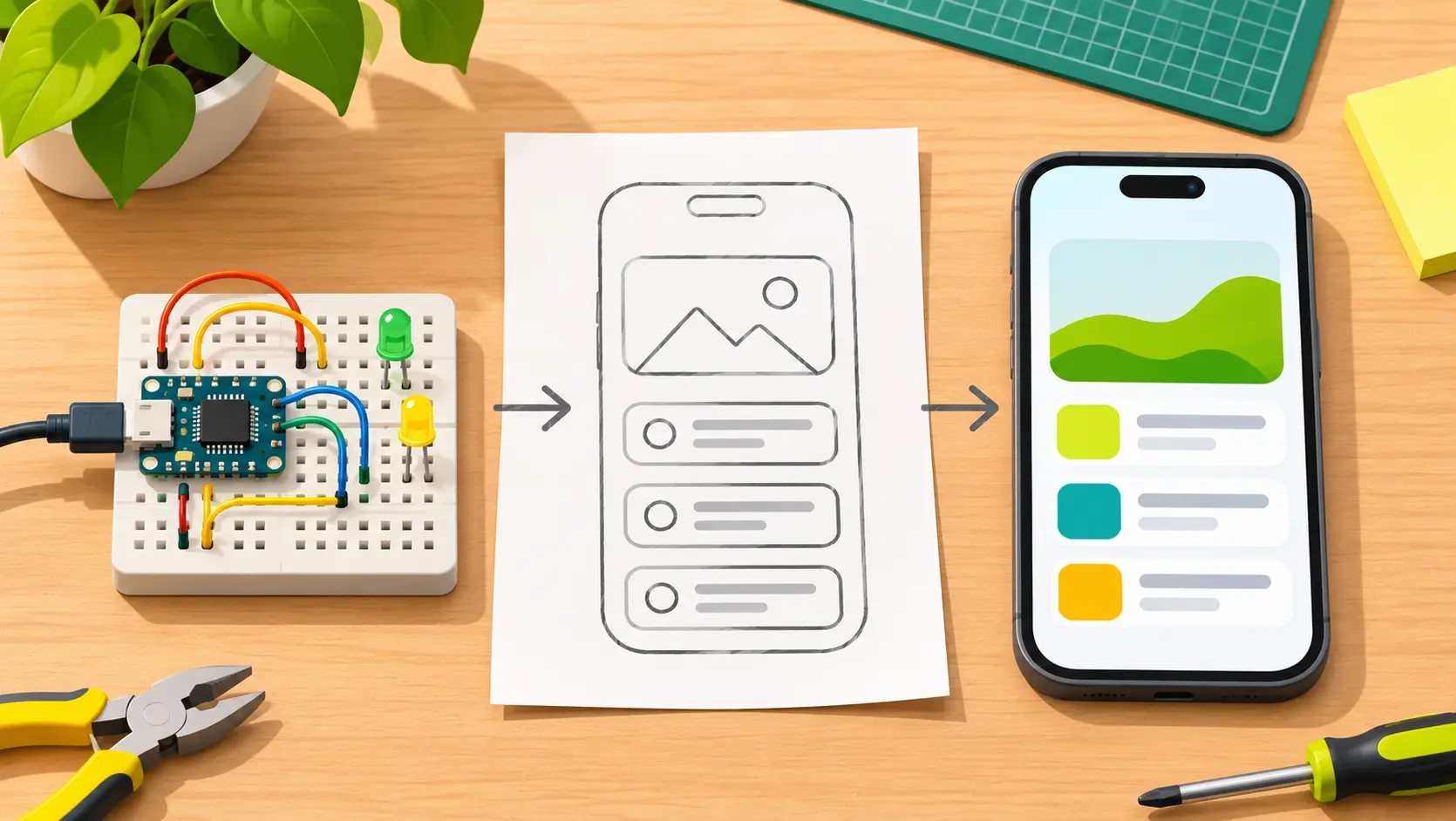
A proof of concept, a prototype and an MVP answer three different questions, and most business ideas only need one or two of them. A proof of concept (PoC) answers "can this be built?" A prototype answers "will people understand it?" An MVP answers "will people pay for it?" Pick the one that matches the question you are actually unsure about, and you can save months and a large share of your budget. This guide gives plain definitions, rough costs and timelines, a comparison table, and the mistakes we see most often.
What is the difference between a proof of concept, a prototype and an MVP?
A proof of concept is a small technical test that checks whether one risky piece of an idea works at all. A prototype is a visual or clickable model of the product with no real backend. An MVP is a working product with only the core features, released to real users.
The three are often described as a sequence, and UXPin's 2026 comparison lays it out that way: PoC to check feasibility, prototype to design and test the experience, MVP to ship and learn from real use. The same article adds the line that matters for a business owner: you do not always need all three. Which ones you need depends on where the risk is.
Here is a made-up example: a lawn care company wants an app where customers photograph their yard and get a quote. The risky part is whether software can estimate area and plant count from a phone photo well enough. That is a PoC question. Whether customers will tap through the flow is a prototype question. Whether they will pay a deposit through the app is an MVP question.
What question does each one answer?
A PoC answers "can it be built?", a prototype answers "will people understand it?", and an MVP answers "will people use it and pay?" Each one is cheap to run when it is pointed at the right question and expensive when it is pointed at the wrong one.
A PoC is for the engineers. It might be a script that pulls data from a legacy system you were told had no API, or a test that an AI model can read your invoices accurately enough. Software Mind's guide, updated in April 2026, describes it as a behind-the-scenes test, not a user-facing model. If the PoC fails, you learn that early and for little money.
A prototype is for your users and stakeholders. It is a set of screens, usually clickable, that lets someone walk through the product and tell you where they got lost. There is no database behind it. A good prototype is the fastest way to find out that your "simple" idea has five screens you forgot.
An MVP is for the market. It runs, it stores real data, real people use it, and it is deliberately small. Cleveroad's May 2025 comparison sums the three questions up as "can we build it?", "how should it work?" and "will people use and pay for it?" That last question cannot be answered with screens. It needs a product someone can commit to.
What does each one cost and how long does it take?
In rough terms, a PoC takes days to a few weeks, a prototype takes one to four weeks, and an MVP takes one to six months. Costs follow the same order: a PoC and a prototype are usually a small fraction of an MVP budget.
| Proof of concept | Prototype | MVP | |
|---|---|---|---|
| Question | Can it be built? | Will people understand it? | Will people use and pay? |
| Who sees it | Your engineers | Users, stakeholders, investors | Real customers |
| What it is | Technical test, often throwaway | Clickable screens, no backend | Working product, core features only |
| Typical time | Days to a few weeks | One to four weeks | One to six months |
| Typical team | One or two developers | Designer, maybe an analyst | Cross-functional build team |
| Output | A yes or no, with evidence | Validated flows and screens | Revenue, usage data, feedback |
The timelines combine UXPin's ranges (days to weeks for a PoC, one to four weeks for a prototype, one to three months for an MVP) with Cleveroad's longer MVP range of two to six months. Cleveroad also prices the smaller two at $5,000 to $15,000 for a prototype and $15,000 to $30,000 for a PoC. Treat those as one agency's ballpark.
MVP budgets vary far more, because "core features" means something different for a booking tool than for a marketplace. Current MVP ranges and what drives them are in MVP development cost and timeline. The point here is the ratio: a prototype that costs a tenth of the MVP can answer half of your open questions before you spend the rest.
Which should a business owner build first?
Build the one that answers your biggest unknown. If you are not sure the technology works, start with a PoC. If you are sure it works but not sure people will get it, start with a prototype. If both are settled and the open question is whether anyone will pay, go straight to an MVP.
Most small business ideas use proven technology: forms, accounts, payments, scheduling, dashboards. For those, a PoC is a waste of money. The risk is in the flow and the demand, so the order is prototype, then MVP.
A PoC earns its place when one piece of the idea is genuinely uncertain: integrating with a system that has no documented API, a machine learning step that has to be accurate to be useful, or a performance requirement nobody has hit before. Run the PoC on that one piece only. Everything else can wait.
Some ideas should start with an MVP and nothing else. If you already run the process by hand in spreadsheets and email, you know people want it and you know the steps. Build the smallest working version and put real customers on it.
Whatever you start with, write down the question. "A prototype to learn whether contractors can complete a quote in under three minutes" is a project. "A prototype" is a line item. If you are briefing an outside team, how to write a software brief covers how to state that question so you get comparable proposals.
What are the common mistakes?
The two mistakes that cost the most are building an MVP when a clickable prototype would have answered the question, and calling a full product an MVP so the scope never gets cut.
- Building an MVP to learn what a prototype would tell you. If the open question is "will people understand this?", screens answer it in two weeks. Code answers it in four months, and by then the budget is gone.
- Calling a full product an MVP. If your MVP has user roles, reporting, notifications, an admin panel and a mobile app, it is a version one. Software Mind warns against treating an MVP as if it were a prototype, or the reverse, because each is scoped for a different purpose. A real MVP should feel slightly embarrassing.
- Running a PoC on proven technology. Stripe payments work. Login works. You do not need to prove it.
- Shipping the prototype as the product. Prototypes have no backend, no security and no error handling. Some no-code prototypes can grow into an MVP, but decide that deliberately.
- Skipping the written goal. Without a stated question, every stage drifts toward "build everything."
At Premier Logic we often start an engagement with a prototype sprint for this reason. The free call ends with a written recommendation naming which of the three you need, and sometimes it says "you do not need us yet, go test the screens."
Quick answers
Do I need a prototype before an MVP?
Usually, yes. A clickable prototype takes one to four weeks and shows you whether people understand the product before you pay for code. Skip it only when you already run the process manually and know the flow, or when the product is so small that building it is as fast as drawing it. For anything with more than a handful of screens, prototype first.
Can a prototype become the product?
Rarely in its original form. A design prototype has no backend, no security and no real data, so the production app is built fresh, using the prototype as the spec. Some no-code or low-code prototypes can grow into a working MVP if they were built on a platform that supports real users, payments and data. Decide that on purpose before you start, not after.
How long does a proof of concept take?
A proof of concept typically takes days to a few weeks, and one agency guide puts the range at three to six weeks with one or two developers. The length depends on how narrow the question is. A PoC that tests one integration or one algorithm is fast. If the PoC is taking months, it has turned into a product and should be re-scoped.
Is a no-code MVP a real MVP?
Yes, if real customers can use it and pay for it. An MVP is defined by its purpose, which is to test demand with a working product, not by the tools used to build it. A no-code MVP may hit limits on performance, custom logic or integrations later, and you may rebuild it. That is a normal outcome, not a failure.
What comes after the MVP?
After the MVP you measure, then decide: scale it, change it, or stop. If users pay and return, the next step is usually hardening (security, performance, support) and the first features users asked for most. If they do not, the MVP did its job by telling you cheaply. Either way, keep the "one question at a time" habit.
Next step
If you have an idea and are not sure whether it needs a proof of concept, a prototype or an MVP, book a free call. We will help you name the open question and you leave with a written recommendation, whether or not we work together.