How Long Does It Take to Build a Website? Real Timelines
Realistic website timelines by site type, from a template site in two weeks to a web app in six months, plus the phases, the usual delays and how to avoid them.
Building a website takes one to three weeks for a template site, six to ten weeks for a custom brochure site, two to four months for an ecommerce store, and four to nine months for a web app. Those are working timelines for a US small or mid-sized business hiring a professional, assuming the content arrives on time. That last part is where most schedules break, so this guide covers the phases, the delays, and what you can do about them.
How long does it take to build a website by type?
A template site takes one to three weeks, a custom brochure site six to ten weeks, an ecommerce store eight to sixteen weeks, and a custom web app four to nine months. The range inside each type comes from page count, integrations and how fast decisions get made.
Elementor's 2026 guide to website timelines puts a professionally built small business site at four to eight weeks, a professionally built ecommerce store at eight to sixteen weeks, and a large custom build or web application at four to six months or more. HostArmada's guide updated in June 2026 says most web projects run ten to sixteen weeks from start to launch, with a basic WordPress site at one to three weeks and a custom WordPress site at four to twelve weeks or longer.
Our ranges sit a little above Elementor's for custom work because we include discovery and the client's content time, which many agency estimates leave out.
- Template site (5 to 8 pages, theme-based). One to three weeks. Design is chosen, not drawn. Most of the time is content and setup.
- Custom brochure site (5 to 15 pages). Six to ten weeks. Discovery, a designed system of templates, build, content loading and QA.
- Ecommerce store (up to a few hundred products). Eight to sixteen weeks. Product data, payments, shipping, tax and app setup add weeks of configuration and testing.
- Custom web app. Four to nine months. Logins, data, workflows and integrations have to be designed, built and tested, and the scope that drives the price drives the time too.
What does each phase of a website project take?
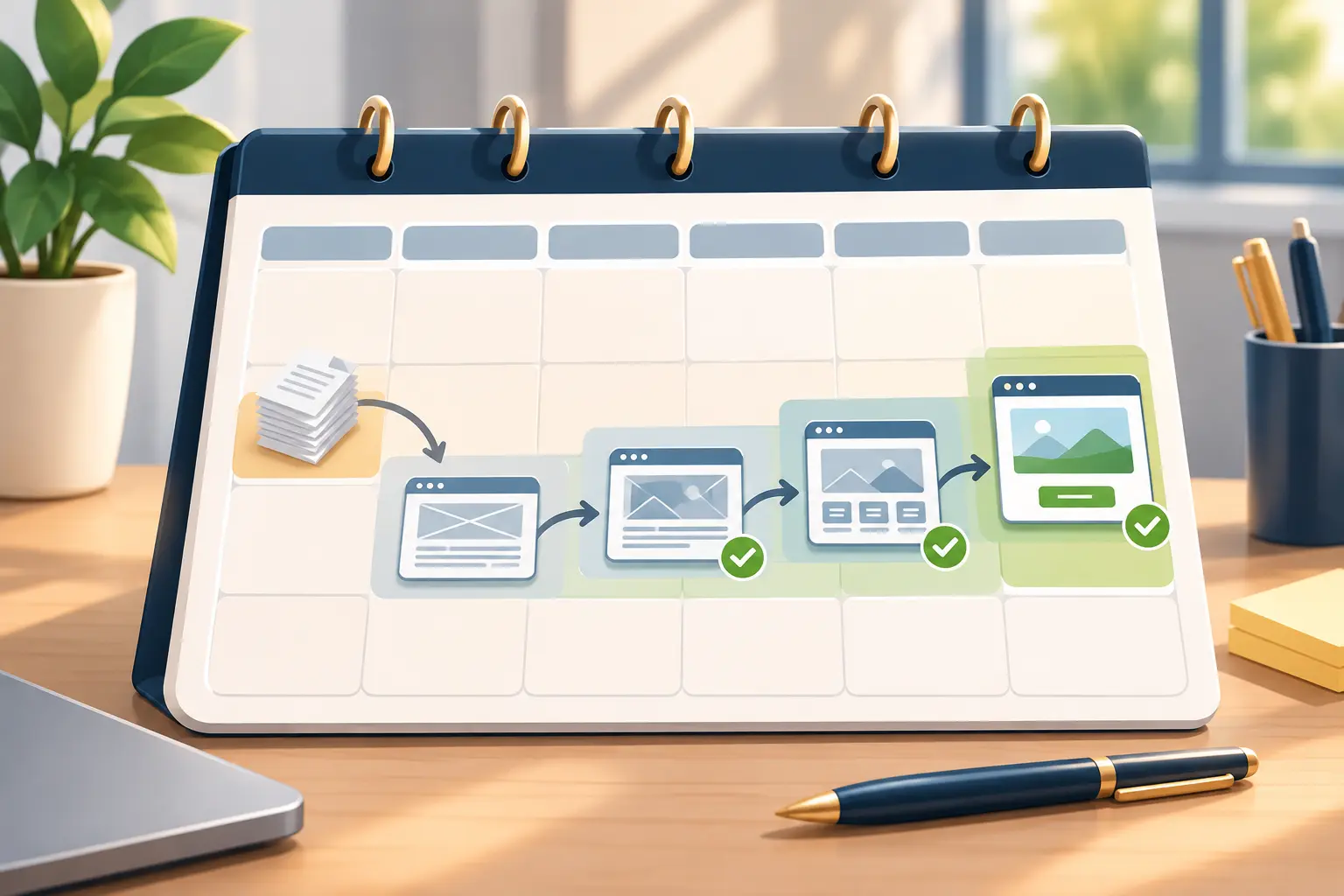
A professional build moves through six phases: discovery (one to two weeks), design (two to four weeks), build (two to eight weeks), content (one to three weeks, often overlapping), QA (one to two weeks) and launch (a day to a week). The phases overlap, so the total is shorter than the sum.
Elementor's guide gives similar figures: strategy and planning one to two weeks, design one to four weeks, development one to eight weeks or more, content population one to three weeks, testing one to two weeks, and launch from a day to a week.
What happens in each:
- Discovery. Goals, audience, sitemap, what the site must do, which integrations it talks to. Short, but skipping it is why projects get rebuilt halfway.
- Design. Wireframes, then designed templates (home, service page, blog, contact). Each round of feedback adds days.
- Build. Templates become a working site on the chosen platform. Forms, tracking and integrations are wired here.
- Content. Copy, images and product data get written, approved and loaded. This runs alongside the build and is usually the long pole.
- QA. Browser and phone testing, form tests, speed, accessibility, redirects if it is a redesign.
- Launch. DNS change, final checks, analytics and Search Console confirmed.
Put a realistic number on each phase before you sign, and ask the vendor which phases depend on you.
Why do website projects take longer than planned?
Projects run late for three reasons, in order: content from the client arrives late, approvals take weeks instead of days, and the scope grows after the design is approved. Technical problems are rarely the cause.
Both guides above say the same thing. Elementor calls client content the number one bottleneck and notes that writing, sourcing and approving it often takes longer than design and build combined. HostArmada calls content supply by far the biggest hold-up. In our experience it is not close: a site that is built in six weeks can wait another six for the copy.
Approvals are second. A single decision-maker who reviews within two days keeps a project on track. A committee that meets every other week can add a month in revisions alone. Scope is third. A "small" request such as a members area, a booking tool or a second language can add weeks, and it almost always arrives after the design is signed off.
Clutch's 2026 web design pricing guide lists the typical project length on its platform at seven months, which says more about how long content and decisions take than about how long code takes.
How can you shorten a website build?
You shorten a build by having the content ready before design starts, naming one person who approves things within two business days, freezing scope once the design is signed off, and choosing a platform the vendor already knows well.
In practice:
- Write first. Draft the copy for every page, or hire the copywriter in week one. Design around real words, not placeholder text.
- Collect assets early. Logo files, brand colors, photos, team bios, product data. Put them in one shared folder before the kickoff.
- One approver, fixed turnaround. Two business days for feedback, written in the agreement.
- Freeze scope after design. New ideas go on a phase-two list, not into the build.
- Keep integrations to what you need at launch. Each one adds setup and testing.
- Pick a known platform. A vendor who builds on WordPress or Shopify every week is faster there than on a tool they are learning on your project.
Timelines also depend on how clearly you brief vendors. Our website design and development RFP template asks for the dates and dependencies up front, and our guide to evaluating web development proposals explains how to judge whether a promised timeline is believable. A proposal that commits to six weeks without asking about your content is guessing.
A realistic week-by-week example
Here is a made-up example for a custom ten-page brochure site for a New York services company, built in ten weeks with content arriving on time.
- Weeks 1 to 2: discovery. Kickoff, goals, sitemap, list of integrations (CRM form, booking tool, analytics). Copywriter briefed. Photo shoot booked.
- Weeks 3 to 4: design. Wireframes in week three, designed home and service templates in week four. One feedback round each.
- Weeks 5 to 7: build and content. Templates built on the chosen platform while copy is written and reviewed. Photos delivered in week six. Content loaded in week seven.
- Week 8: QA. Phone and browser testing, form submissions checked in the CRM, speed and accessibility checks, redirects mapped from the old site.
- Week 9: client review and fixes. Final walkthrough, last edits, training session for the team.
- Week 10: launch. DNS switched midweek, analytics and Search Console confirmed, a post-launch check on the top pages.
Change one input and the schedule moves. Copy two weeks late pushes launch to week twelve. A second approver who reviews on a monthly cycle pushes it further. At Premier Logic the developers and the SEO team plan launches together, which is why redirects and tracking appear in week eight and not as an afterthought in week eleven. If you are weighing cost against speed, our guide to website cost for a small business shows how the same choices move the price.
Quick answers
How long does it take to build a 5-page website?
One to three weeks with a professional if the site uses a theme and the content is ready, and four to eight weeks if the design is custom. The build itself is a few days either way. The rest is writing the copy, gathering images, reviewing the design and testing the forms. Bring finished content to the kickoff and a five-page site can launch inside a month.
Why does my web designer take so long?
Usually because something is waiting on you: copy, photos, logins, or a decision. Ask for a list of open items with an owner next to each. If the open items are all on the vendor's side, ask for a revised schedule with dates. Designers also slow down when scope keeps changing, so check whether requests added after the design was approved are stretching the build.
Can a website be built in a week?
Yes, if it is a template site with a handful of pages and the content is finished before work starts. A page builder or a WordPress theme can be set up, filled and tested in five working days. A custom design cannot: discovery, design rounds and QA alone take longer than a week. Treat any custom quote promising a one-week build as a sign that something is missing from the scope.
How long does an ecommerce website take?
Eight to sixteen weeks for a store with up to a few hundred products on Shopify or WooCommerce. Design and build are similar to a brochure site. The extra weeks go to product data, variants, payment and shipping setup, tax rules, app configuration and checkout testing. Stores with thousands of products, an inventory system to connect, or custom pricing rules run four to eight months.
What is a realistic timeline for a website redesign?
Eight to twelve weeks for a custom redesign of a 10 to 30 page site, including migration. A redesign has everything a new site has plus a URL map, redirects, content migration and reconnecting integrations, so it is rarely faster than a new build of the same size. Same-platform visual refreshes that keep the URLs can finish in four to six weeks.
Next step
If a vendor has quoted you a timeline and you want to know whether it is realistic, book a free call. We will walk through the phases with you and flag what depends on your team. You leave with a written recommendation, whether or not we work together.