Custom Software vs. Off-the-Shelf: A Decision Framework for Growing Businesses
A practical five-factor scoring framework for deciding when to buy software, when to build it, and when the right answer is a hybrid of both.
Every growing business hits the same moment. A process that used to live in one person's head now involves six people, three tools and a shared folder nobody trusts. Someone says "we need real software for this." Then the argument starts: buy something that exists, or build something that fits?
Both camps are usually right about something. Off-the-shelf software is fast and cheap to start. Custom software fits the way you actually work. The mistake is treating this as a matter of taste. It is a decision you can score, and this post gives you the scoring framework, explains when each option wins, and walks through the hybrid path most growing businesses end up on anyway.
Start with what the decision is really about
"Custom vs. off-the-shelf" sounds like a technology question. It is not. It is a question about how much of your competitive advantage lives inside this particular process.
If the process is the same at every company in your industry (payroll, email, accounting, file storage), there is no advantage in doing it differently. Buy the standard tool. Nobody wins deals because their payroll runs on bespoke code.
If the process is how you win (the way you quote jobs, schedule crews, route orders, or price risk), then forcing it into a generic tool means forcing your advantage into a shape designed for your competitors. That is where custom software earns its keep.
Most decisions sit between those extremes, which is why a scoring framework helps.
The five-factor scoring framework
Score each factor from 1 to 5. A high score favors building; a low score favors buying. Do this with the people who use the process daily, not only with leadership. They know where the real friction is.
1. Fit to your core process. How much would you have to change how you work to fit the off-the-shelf tool? Score 1 if a standard tool already matches 90 percent of what you do. Score 5 if every demo ends with "we could make that work if we also changed how we do X and Y." Workarounds have a cost that never shows up on the invoice: training, errors, and people quietly going back to spreadsheets. If that last part sounds familiar, read our post on the 7 signs you've outgrown spreadsheets.
2. Cost over three years, including subscriptions. This is where most buy-vs-build math goes wrong. People compare a one-time build quote against a monthly fee and stop there. Run both out for 36 months. Per-seat pricing grows with headcount. Add-ons and tiers appear. Vendor price increases are real: Vertice found SaaS prices rose 11.3 percent in a single year, roughly four times general inflation, and per-employee software spend had reached about $9,000 a year by March 2025. On the build side, include hosting, maintenance and a realistic budget for changes. Score 1 if the subscription stays clearly cheaper across three years. Score 5 if the build pays for itself inside that window.
3. Integration. How many other systems does this process touch, and how well does the off-the-shelf option talk to them? A tool that fits perfectly but needs manual exports to your accounting system is not a fit. Score 1 if the vendor has native integrations with everything you use. Score 5 if you would be paying for middleware, a second tool, or a person to move data by hand.
4. Control and lock-in. Who owns the data, the workflow and the roadmap? With a subscription, the vendor decides which features ship, which get removed, and what happens when they are acquired. Your data lives in their shape. Score 1 if switching later would be painless and the vendor is stable. Score 5 if the process is so central that losing access, or losing a feature you depend on, would stop the business.
5. Speed to value. How fast do you need something working? Off-the-shelf is live this week. Custom software takes months. Score 1 if you need it now and the pain is acute. Score 5 if you can tolerate a build timeline because the current workaround is survivable for a while.
Add the scores. A total of 10 or under points firmly at buying. A total of 20 or above points at building. The middle band, 11 to 19, is where the hybrid path (below) almost always wins.
When off-the-shelf wins
Off-the-shelf software wins when the process is a commodity, the team is small for that function, and speed matters more than fit.
It also wins when you have not yet figured out how the process should work. Buying a standard tool is a cheap way to learn which features you use, which you ignore, and where the gaps are. That knowledge is the best input to a custom build later, if you ever need one.
The honest caution: subscriptions are easy to start and hard to notice. Zylo's 2025 SaaS Management Index found the average company carried 275 applications and that 53 percent of licenses went unused in a typical 30-day window. Growing businesses are not immune. Every tool that solves one team's problem adds another login, another export and another monthly line item. A single tool is cheap. The twelfth tool that overlaps with the other eleven is not.
When custom software wins
Custom software wins when the process is how you make money, when it touches many other systems, and when you expect to run it for years.
The cost question deserves a straight answer. Market pricing for a small-business application (a CRM, an internal tool, a scheduling or quoting system) sits in a wide band. Fuzen's 2026 guide puts it at roughly $30,000 to $150,000 over three to six months, with simpler MVPs below that and enterprise systems well above. Hourly benchmarks for US agency developers run from about $165 to $350 an hour depending on seniority. We break down what drives these numbers in our guide to custom web app cost in 2026.
Those figures sound large next to a $49-a-seat subscription. They often are not large next to the three-year total of five overlapping subscriptions plus the hours your team spends stitching them together. The right comparison is not "build cost vs. subscription cost." It is "build cost vs. subscription cost plus the labor the subscription fails to remove." That is the lens we use at Premier Logic: software is worth building when it returns more hours than it costs, and keeps returning them every month.
Custom also wins on control. You own the code, the data model and the roadmap. Nobody deprecates the feature you rely on or doubles the price at renewal.
Client portals are a common place where this decision gets made. We walk through it in client portal software, build or buy.
The hybrid path: buy the commodity, build the differentiator
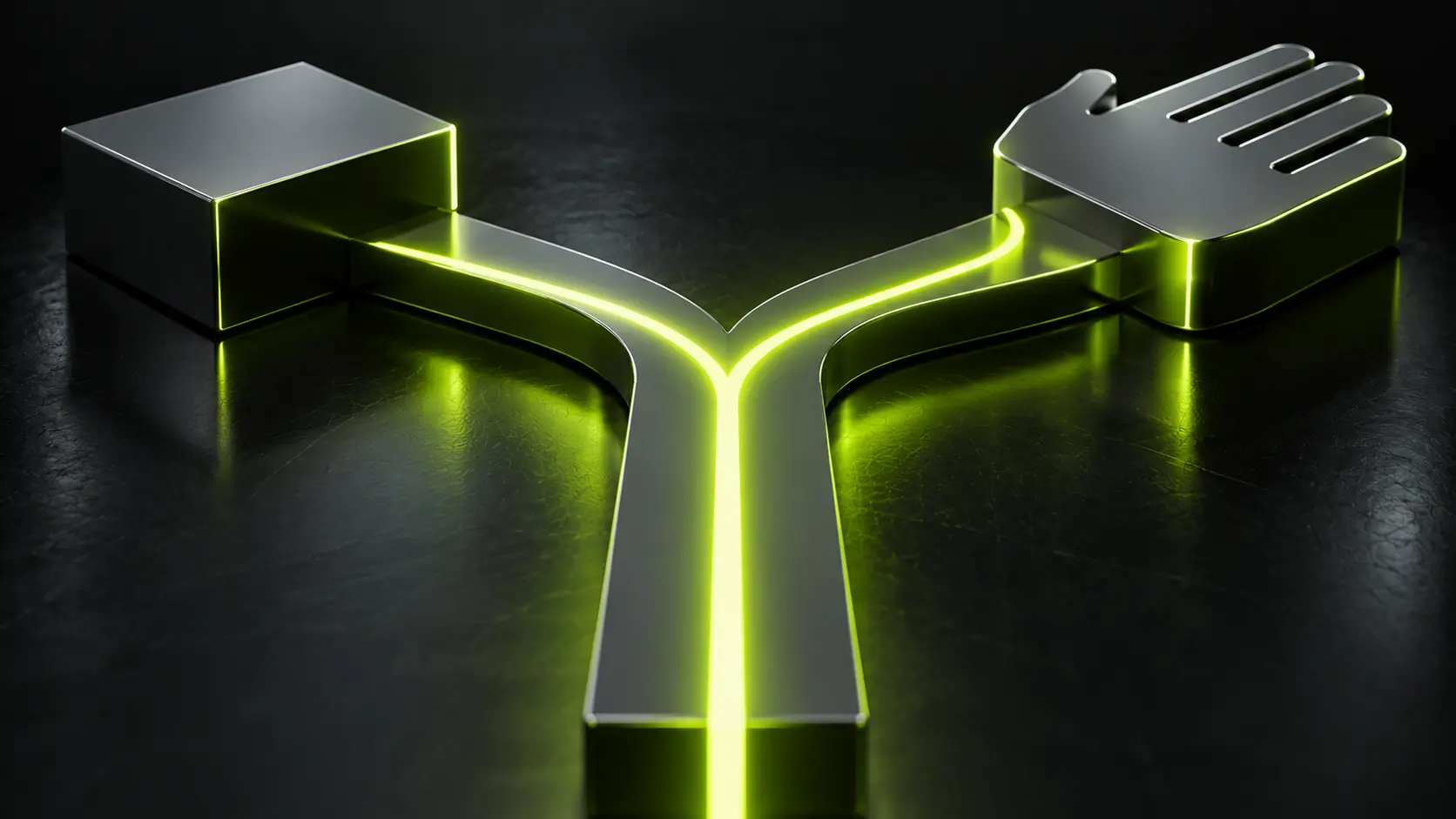
Here is where most growing businesses should land. You do not pick one. You draw a line.
Below the line sits everything that is the same at every company: accounting, email, documents, payroll, calendar, generic CRM. Buy it. Pick stable vendors with good APIs. Do not customize beyond configuration.
Above the line sits the one or two processes that make you different. Build those, and build them to pull from and push to the tools below the line. A quoting engine that reads from your CRM and writes to your accounting system. A scheduling tool that knows your rules and talks to the calendar everyone already uses. A client portal that sits on top of the systems you already pay for.
This approach keeps the custom build small and focused, which keeps the cost and timeline down. It also means your off-the-shelf tools become replaceable. If the CRM vendor raises prices, you swap the CRM and keep the quoting engine. The thing you built is the thing you keep.
A few rules make hybrid work well. Pick off-the-shelf tools with real APIs, not just export buttons. Keep the custom layer thin at first; add to it only when a workaround starts costing real hours. And give one party responsibility for the whole stack working together, so integration problems do not fall between a vendor's support desk and nobody.
If you decide to build but want to test the idea before committing the full budget, start smaller with an MVP. Here is what an MVP costs and how long it takes.
A worked example
Picture a 40-person service business. Jobs are quoted by hand in a spreadsheet, scheduled in a generic project tool, invoiced in accounting software, and tracked in a CRM that nobody updates. Four subscriptions, plus a lot of copying.
Scoring it: fit is poor because the quoting logic is theirs alone (5). Three-year cost is high because four tools scale with headcount (4). Integration is weak since all four need manual bridging (4). Lock-in is moderate (3). Speed is not urgent because the workaround limps along (4). Total: 20.
The score says build, but the hybrid rule narrows what to build. Keep the accounting software. Keep the calendar. Replace the spreadsheet and the project tool with one custom quoting-and-scheduling system that writes invoices into accounting automatically. Two subscriptions stay, two go, and the piece that is unique to the business becomes an asset instead of a recurring fee.
Next step
If you are weighing this decision right now, run the five scores with your team before you talk to any vendor or developer. If you would like a second opinion, book a free call. We will spend 30 minutes on your process and send a written recommendation: buy, build, or where to draw the hybrid line. No pitch, and the recommendation is yours to use with whoever you choose.
- custom software
- off-the-shelf software
- build vs buy
- software strategy